Cybersecurity news can feel overwhelming because every week brings new vulnerabilities, attacks, and warnings. But the most useful question is not simply “What was hacked?” It is “What can we learn from it?”
This week, three themes stand out: attackers are still targeting unpatched software, internet-facing devices remain dangerous weak points, and AI is making vulnerability discovery faster for both defenders and attackers.
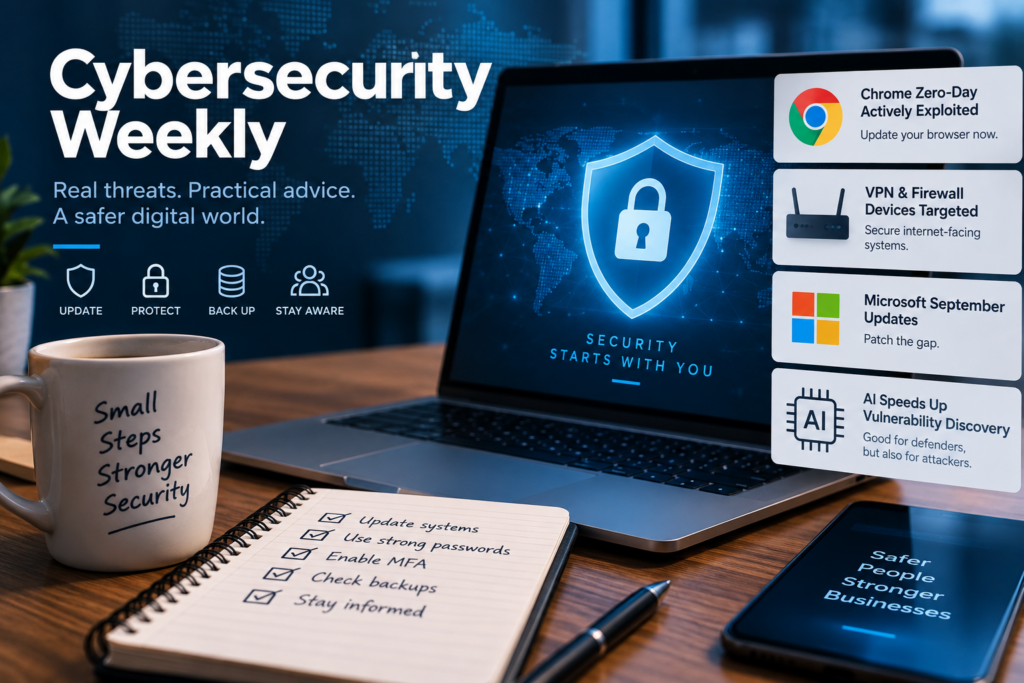
Chrome Zero-Day Shows Why Browser Updates Matter
On September 3, Google released a Chrome security update that fixed 12 vulnerabilities. One of them, CVE-2026-85046, was already being exploited in real attacks. Google described it as a high-severity vulnerability affecting Chrome’s V8 JavaScript engine. (Chrome Releases)
A browser vulnerability is important because people use browsers constantly. A malicious website may sometimes be enough to begin an attack, depending on the vulnerability and the attacker’s technique.
The lesson is simple: browsers should not be treated like ordinary applications that can be updated “later.”
Chrome normally updates automatically, but users should still occasionally check that the browser has actually restarted and installed the latest version. People using Chromium-based browsers such as Microsoft Edge, Brave, Opera, or Vivaldi should also keep them updated because some vulnerabilities can affect the shared Chromium components.
For small businesses, automatic browser updates should be enabled wherever possible.
VPN and Firewall Devices Continue to Be Major Targets
Another important development involves vulnerabilities affecting network edge devices.
Recent threat reporting highlighted active exploitation of SonicWall SMA1000 appliances, including CVE-2026-83548 and CVE-2026-83549. These types of devices often provide remote access into company networks. Attackers have been exploiting weaknesses in internet-facing VPNs, firewalls, and similar systems because compromising one can provide a doorway into the wider internal network. (Cyware)
This teaches an important cybersecurity principle: the most dangerous vulnerability is often not on an employee’s laptop. It may be sitting on the edge of the network.
Businesses should know exactly which devices are exposed to the internet. VPN gateways, firewalls, routers, remote-access systems, web servers, and administration panels should receive especially fast security updates.
Administrators should also avoid leaving management interfaces publicly accessible unless absolutely necessary.
September Updates Highlight the Growing “Patch Gap”
Microsoft released another large group of security updates this week, including fixes affecting Windows and .NET components. For example, Microsoft’s September 8 updates addressed vulnerabilities including CVE-2026-62886, an elevation-of-privilege vulnerability, and CVE-2026-69522, which could allow remote code execution in .NET Framework. (Microsoft Support)
Chrome 153 also arrived on September 8 with a very large number of security fixes. (Chrome Releases)
The important idea here is the patch gap.
A patch may exist, but an organisation is still vulnerable until the patch is actually installed.
Attackers know this. Once vulnerability information becomes public, criminals can begin searching the internet for organisations that have not updated.
Small businesses therefore need a simple patch routine instead of relying on someone remembering to update systems occasionally.
A practical approach is to enable automatic updates for everyday devices, review critical business systems weekly, and prioritize anything that is publicly accessible.
AI Is Changing Vulnerability Discovery
Another developing cybersecurity issue is the increasing use of powerful AI systems for security research.
Recent reporting suggests advanced AI tools are helping researchers discover software vulnerabilities much faster than traditional manual methods. This can be positive because security companies can find and repair problems sooner. But the same improvement in capability may eventually help attackers discover weaknesses faster as well. (The Verge)
This does not mean AI suddenly makes every system unsafe.
It means organisations may have less time between vulnerability discovery and attempted exploitation.
The security strategy therefore remains familiar: reduce unnecessary exposure, update quickly, monitor systems, and limit what attackers can access if one account or device becomes compromised.
What Should You Do This Week?
For individuals, the most useful actions are simple: update your browser, install operating-system updates, keep phones and applications current, use multi-factor authentication, and avoid installing software from unofficial download websites.
For small businesses, add several additional steps. Check which systems are directly exposed to the internet, update VPNs and firewalls quickly, remove unused accounts, maintain offline or protected backups, and regularly review administrator access.
The bigger lesson from this week is that cybersecurity is rarely about finding one perfect security product.
Most successful defence comes from doing ordinary security tasks consistently.
Patch quickly. Reduce exposure. Use strong authentication. Maintain backups. Monitor important systems.
Attack techniques continue to evolve, but these basic controls remain some of the strongest protections available.